
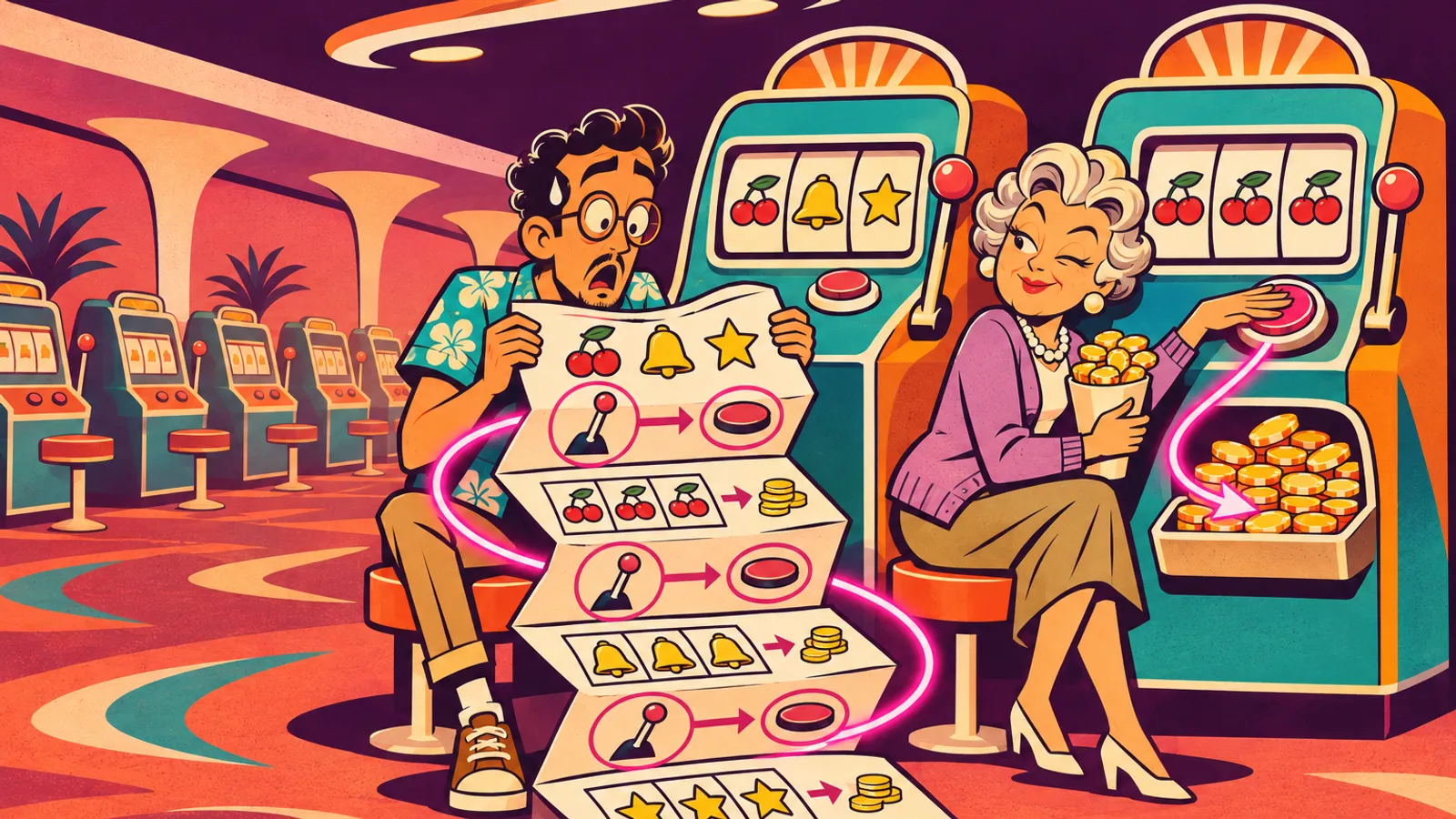
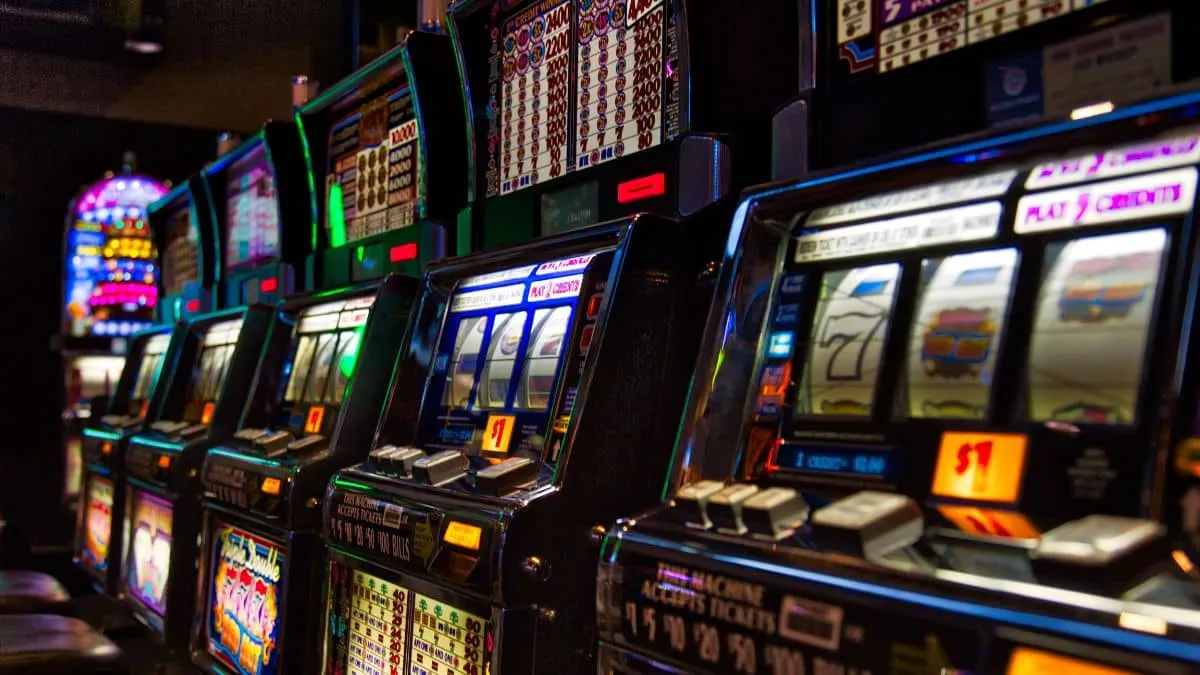
Slot machines fill most of every Las Vegas casino floor, and they are the easiest game to start with: no rules to learn, no dealer, no one watching. They are also the game people understand least. This guide explains how a modern slot decides each spin, how to play one in a Vegas casino from the first bill to the cash-out ticket, where slots pay back the most according to the state’s own figures, and what happens when you hit a jackpot.
Try It First: Our Free Practice Slot
This practice slot works like a classic three-reel Vegas machine with one pay line. It plays with $100 of play money, and the panel beside the reels keeps the score that a real machine never shows you: what you bet in all, what came back, and the machine’s own long-run return.
Three things to try:
- Play 1,000 spins on each machine. Over a few spins anything can happen. Over a thousand, your return gets close to the machine’s, and the balance line slopes down at the speed the payback sets.
- Switch from low to high volatility. Both machines pay back the same in the long run. The low-volatility one pays small amounts often; the high-volatility one goes quiet for long stretches and then pays big. The second one feels more exciting and empties a budget faster in most sessions.
- Watch for a near miss. Two sevens on the line and the third just above it looks like bad luck by an inch. It is just another losing spin, decided the moment you pressed the button.
How a Slot Machine Decides a Spin
Every modern slot runs a random number generator (RNG), a program that produces numbers nonstop, even when nobody is playing. When you press Spin, the machine takes the current numbers and turns each one into a stop on a reel. The spinning reels you watch are a show: the result was set before they started moving.
Three consequences follow, and they settle most slot myths:
- No machine is ever “due.” A machine that has not paid for hours is exactly as likely to pay on the next spin as one that just hit.
- Timing, speed and stopping the reels change nothing. Pressing the button again to stop the reels early only ends the animation sooner.
- Leaving a machine costs you nothing. The person who sits down after you and wins would not have hit the same result: it depends on the exact moment of their spin.
Payback, hold and volatility
A machine’s payback is the share of the money played that it returns over a very long time. A machine with a 92% payback keeps, on average, 8 cents of every dollar played: that 8% is the casino’s hold. It is an average over millions of spins, not what happens in your session.
Volatility describes how that return is paid out. A low-volatility game returns small amounts often; a high-volatility game pays rarely but bigger, with long losing streaks in between. Two machines with the same payback can feel completely different, which is exactly what the practice slot above shows.
Video slots add pay lines: lines across the reels on which a combination counts. A game can have 20, 50 or hundreds of ways to win, and your bet per spin is often the bet per line times the number of lines. That is why a “penny” slot rarely costs a penny a spin.

How to Play a Slot Machine in a Vegas Casino
- Get a players card first. Every casino group has a free rewards program: insert the card before you play and every spin earns points, free play and offers. See our guide to Las Vegas players cards.
- Pick a machine. The denomination (1¢, 5¢, 25¢, $1…) is the value of one credit; the screen shows the minimum and maximum bet. You must be 21 to play.
- Insert cash or a ticket. Almost every machine takes bills and printed tickets rather than coins. Your money becomes credits on the screen.
- Choose your bet. On a video slot, pick the lines and the bet per line; on a reel slot, the number of credits. Check the pay table (the “i” or “help” button) to see what each combination pays and whether the top award needs the maximum bet.
- Spin. The machine credits any win automatically.
- Cash out. The Cash Out button prints a ticket with your balance. Take it to a kiosk (a cash redemption machine) or the cashier’s cage, or put it into another machine.
What the Symbols and Features Do
| Feature | What it does |
|---|---|
| Wild | Stands in for other symbols to complete a winning combination. |
| Scatter | Pays wherever it lands, not only on a line; three or more often start free spins or a bonus. |
| Multiplier | Multiplies a win, usually by 2x to 10x, sometimes far more in bonus rounds. |
| Bonus symbol | Starts a bonus game, such as a wheel or a pick-a-prize screen. |
| Stacked symbols | Fill several positions on a reel at once, which helps complete lines. |
| Sticky symbols | Stay in place for several spins, usually during free spins. |
None of these features changes the machine’s payback: they decide how the same long-run return is paid out.
Where Slots Pay Back the Most in Las Vegas
Individual machines don’t publish their payback, but the Nevada Gaming Control Board publishes what slots kept, area by area and by denomination. These are the figures for 2025:
| Area | Slots kept (all) | Penny slots kept |
|---|---|---|
| The Strip | 7.83% | 10.79% |
| Downtown | 8.30% | 10.95% |
| North Las Vegas | 7.47% | 8.71% |
| Boulder area (locals casinos) | 6.48% | 8.72% |
What it means in practice:
- Higher denominations pay back more. Statewide, penny slots kept 9.09% in 2025 and quarter slots 7.58%. A dollar machine usually returns more than a penny machine in the same casino.
- Locals casinos beat the Strip. The Boulder area, home to casinos such as Sam’s Town and Boulder Station, kept the least of any Las Vegas area.
- Downtown is not looser than the Strip for slots. It kept slightly more in 2025, overall and on penny slots.
- “Loose slots” signs are marketing. The area averages above are the only official numbers.
Progressive Jackpots and “Must-Hit-By” Machines
On a progressive slot, a small part of every bet feeds a jackpot that grows until someone wins it. It can be one machine, a bank of machines in one casino, or a network across many casinos, which is how the biggest jackpots reach millions. The price is a lower return on everyday spins, and some games only pay the progressive on a maximum bet: check the pay table before you play.
A must-hit-by progressive has to pay before it reaches the amount shown (“must hit by $500”). The closer the jackpot is to that cap, the better the odds that it lands soon, which is the one case where watching a machine actually means something.
Hitting a Jackpot: Hand Pays and Taxes
Since January 1, 2026, a slot jackpot of $2,000 or more locks the machine: an attendant comes to verify it, asks for your ID and pays you by hand with a Form W-2G for the IRS. The threshold had been $1,200 since 1977. From 2027, the IRS will adjust it each year for inflation. Many players tip the attendant on a hand pay.
Gambling winnings are taxable even below that amount. Visitors who are not US residents generally have 30% withheld on a jackpot, reported on Form 1042-S instead of a W-2G; some countries’ tax treaties lower that, and the casino will tell you what it needs.
Tips Before You Sit Down
- Decide your budget and your time before you play, and stop when either runs out, or when it stops being fun.
- Play a denomination you can afford for a while. A higher denomination returns more per dollar, but only if your budget lasts.
- Use your players card every time. Free play and comps are the only part of slot play that works in your favor.
- Don’t save a machine for long. A drink or a card left on a seat holds it for a short break, not for an hour.
If gambling stops being fun, the National Problem Gambling Helpline is free and confidential: call or text 1-800-MY-RESET (1-800-697-3738).
Frequently Asked Questions
Can you win at slots with a strategy?
No strategy changes the result of a spin: the random number generator decides it. What you can control is the machine (higher denominations and locals casinos pay back more), your bet size, your budget and the rewards you collect with a players card.
How old do you have to be to play slots in Las Vegas?
21. Casinos check ID, and a jackpot won by someone under 21 is not paid.
Do casinos change the odds on a machine at night or on weekends?
A machine’s payback comes from its approved software, and Nevada regulates any change to that setting. Nothing in a spin depends on the time of day or how busy the casino is.
What is the best slot machine to play in Las Vegas?
The one you enjoy at a bet your budget can sustain. On the numbers alone, a higher-denomination machine in a locals casino pays back the most; a penny video slot on the Strip pays back the least.